


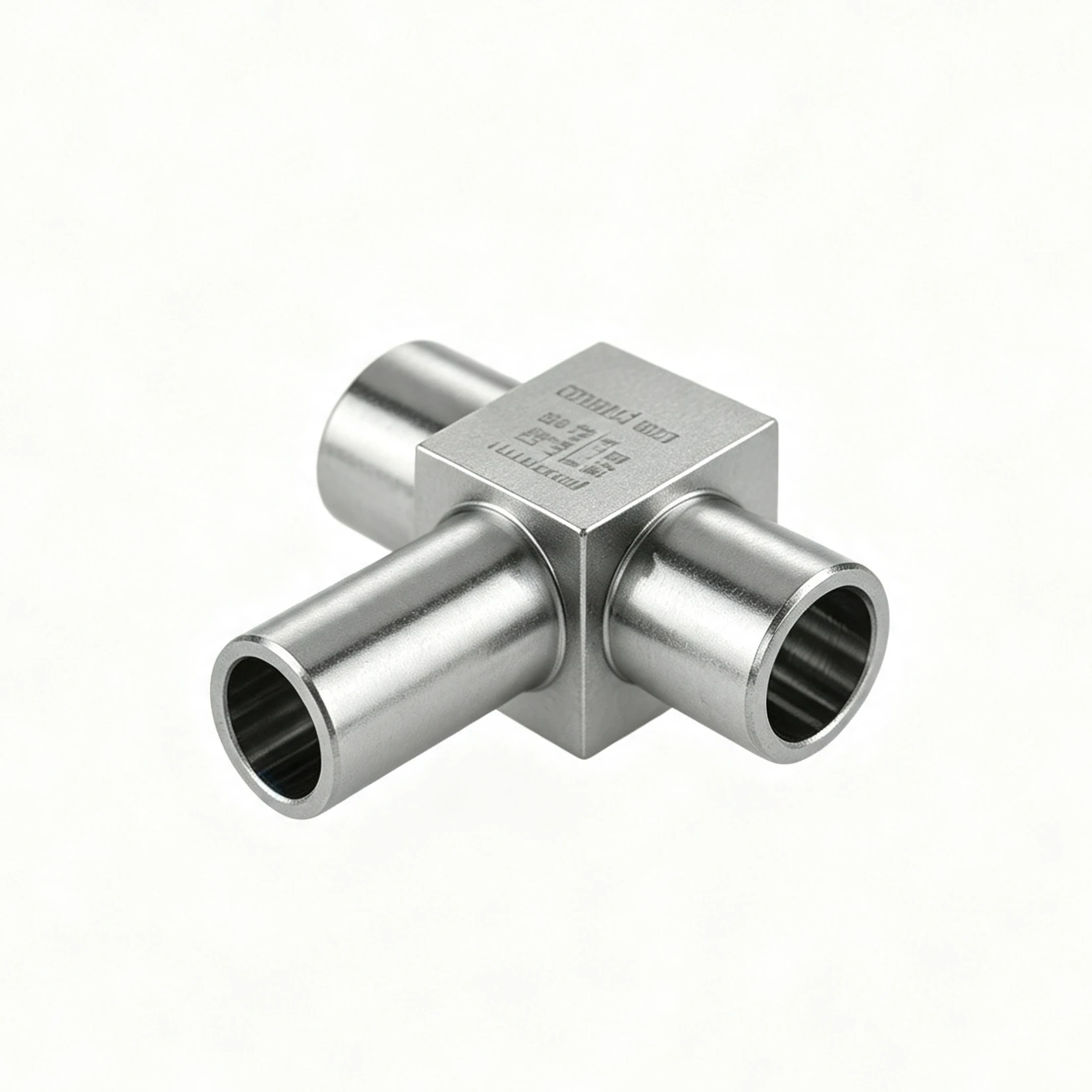
Three-Port Distribution Functions
A three-way coolant manifold can divide one supply into two branches, combine two returns into one outlet, or connect three segments in another controlled arrangement. Applications include GPU and CPU cold plate loops, battery energy storage, EV thermal systems, industrial chillers, laser cooling, and electronics test equipment.
Port count alone does not define flow direction or performance. The drawing should identify inlet and outlet roles, required branch flows, allowable pressure drop, installation orientation, coolant, temperature range, pressure envelope, and any valves or restrictions elsewhere in the circuit.
Flow Split and Pressure-Drop Design
Coolant follows the complete resistance of each branch. Even a symmetric junction may deliver unequal branch flow when hoses, adapters, elevations, cold plates, or connector losses differ. Begin with target flow and pressure-drop curves for each load, then model or test the combined network across expected coolant temperatures and pump operating points.
| Design variable | Effect on distribution |
|---|---|
| Port and bore diameter | Controls velocity and contributes to friction and local loss |
| Intersection shape | Affects separation, turbulence, recirculation, and branch loss |
| Branch resistance | Hoses, fittings, cold plates, and valves often dominate the actual flow split |
| Coolant temperature | Changes viscosity and therefore system resistance |
| Orientation and trapped gas | Can affect filling, venting, local blockage, and measurement stability |
If branch balance is critical, provide balancing geometry, calibrated restrictions, valves, sensors, or a tested system-level solution rather than expecting a bare T-junction to regulate flow.
CNC Machining the Junction Block
A three-way manifold may be machined from bar or billet using turning, milling, drilling, boring, reaming, and finishing. Stable functional datums are needed to control port position, angular relationship, bore alignment, wall thickness, sealing features, and the external mounting envelope.
Intersecting holes deserve special attention. A drill can break into another passage with a partial edge that retains a burr or creates a sharp transition. The process plan should define tool approach, breakthrough control, internal deburring, inspection access, flushing, and how chips are proven absent. If plugs or joined features close machining access, define their materials, sealing method, retention, and validation.
Ports, Tube Interfaces, and Seals
For welded tubes, brazed tubes, press fits, O-ring interfaces, or other custom assemblies, define port diameter and tolerance, engagement length, roundness, surface finish, lead-in, concentricity, shoulder location, edge condition, and the complete joining or sealing process.
For removable tube interfaces, review O-ring coolant adapter design. For tight routing near the junction, see the 90-degree elbow fitting guide.
Cleaning, Inspection, and Testing
- Material: verify the specified alloy and condition with the required traceability.
- Dimensions: inspect port locations, bores, sealing features, mounting datums, wall thickness, and critical relationships.
- Internal condition: verify burr removal, passage continuity, cleanliness, and closure of any machining access.
- Leak integrity: define test medium, pressure, temperature, stabilization, dwell, and acceptance limit.
- Proof pressure: validate structural integrity using a safe, documented method appropriate to the design.
- Hydraulics: measure total pressure drop and individual branch flow where distribution is a functional requirement.
- Packaging: dry as specified, cap all ports, protect sealing surfaces, and preserve lot identification.
Frequently Asked Questions
What does a three-way coolant manifold do?
It joins or divides coolant among three ports, such as one supply feeding two branches or two returns combining into one outlet.
Will a symmetric three-way manifold split flow equally?
Not necessarily. The complete resistance of every connected branch controls distribution.
Why are intersecting passages difficult to machine?
Breakthrough can leave burrs, steps, sharp edges, and trapped chips that affect cleanliness, pressure loss, and durability.