


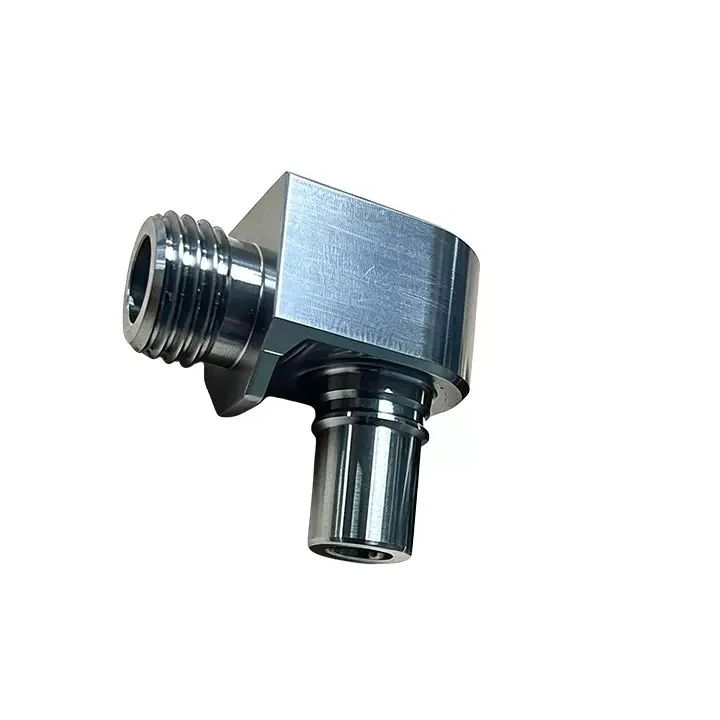
Why Use a Right-Angle Coolant Adapter?
A 90-degree liquid cooling elbow changes line direction where a straight connector would force a tight hose bend, collide with a chassis wall, or obstruct neighboring hardware. Common integration points include cold plates, coolant manifolds, server trays, CDU piping, battery modules, and industrial electronics.
The envelope benefit must be evaluated together with assembly access. A compact elbow still needs tool clearance, thread engagement, a controlled sealing method, and space for the hose or mating connector. Orientation is often a functional requirement because rotating a fixed elbow after sealing can damage the joint or misalign the downstream line.
Flow-Path and Geometry Decisions
| Feature | Design question | Manufacturing or system effect |
|---|---|---|
| Internal bore | What minimum area and transition shape are required? | Small steps, drill intersections, and sharp turns can increase pressure loss or trap debris |
| Turn geometry | Is the passage drilled, milled, formed, or made from joined pieces? | The route affects access, burr removal, plugs, joining, and inspection |
| Threaded end | What standard, class, engagement, runout, and seal method apply? | Ambiguous threads create mating, torque, and leakage risk |
| Connector end | Is it a tube, O-ring, quick-disconnect, hose, or custom interface? | Concentricity and surface finish may control sealing and retention |
| Body envelope | Where are wrench flats, datums, and keep-out zones? | Workholding and installation access must be designed together |
CNC Machining Requirements
A one-piece elbow may combine turning, milling, drilling, threading, and precision finishing. The process plan should establish stable datums between perpendicular features and protect finished sealing surfaces through later operations. When intersecting drilled passages create an internal burr, the drawing should define the acceptable edge condition and the supplier should use a qualified deburring and cleaning method.
Critical characteristics can include thread pitch diameter, port position, perpendicularity, sealing diameter, O-ring surface finish, bore size, wall thickness, and wrench-flat orientation. Visual brightness does not establish roughness or passivation. Define measurable requirements and the final condition after all machining, treatment, and cleaning steps.
Threads and Sealing Interfaces
A male threaded coolant connector may seal on tapered threads, a bonded washer, a face seal, an O-ring, or another controlled feature. Do not assume the thread itself provides the seal. Specify the thread standard and size, tolerance class, gauge method, seal location, mating material, lubricant or sealant, installation torque, and reuse policy.
For elastomeric seals, control groove geometry, edge breaks, lead-in, squeeze, stretch, surface finish, and coolant compatibility. For thread sealants, evaluate chemical compatibility, curing, particle release, application quantity, and the risk of material entering the flow path.
Inspection and Functional Validation
- Verify material and the released drawing revision before machining.
- Inspect threads with the specified gauges and record critical port orientation where required.
- Measure sealing diameters, faces, runout, perpendicularity, and bore restrictions from functional datums.
- Confirm internal burr removal and cleanliness using an agreed visual or indirect method.
- Leak test the finished adapter with a defined medium, temperature, pressure, dwell, and acceptance limit.
- Measure pressure drop when the elbow geometry is hydraulically significant to the cooling loop.
- Protect clean ports and sealing surfaces with controlled caps and packaging.
For nearby sealed tube interfaces, see the O-ring tube adapter guide. For branch distribution, compare three-way coolant manifolds.
RFQ Information for a Custom Elbow
Provide 3D and controlled 2D data, material, heat treatment or passivation, all thread and seal details, critical dimensions and tolerances, coolant, pressure and temperature range, flow or pressure-drop target, cleanliness, leak-test method, finish, quantity, inspection records, packaging, and traceability. If orientation matters after installation, define it relative to functional datums.
Frequently Asked Questions
Why use a 90-degree liquid cooling elbow fitting?
It redirects a coolant line in a compact space and can reduce hose bending or interference near other components.
Does a 90-degree elbow always create high pressure drop?
No single answer applies. Loss depends on bore, bend geometry, transitions, surface condition, coolant, and flow regime.
Which thread should a coolant elbow use?
Use the exact standard required by the mating component and sealing concept, with size, class, gauge, engagement, and torque defined.